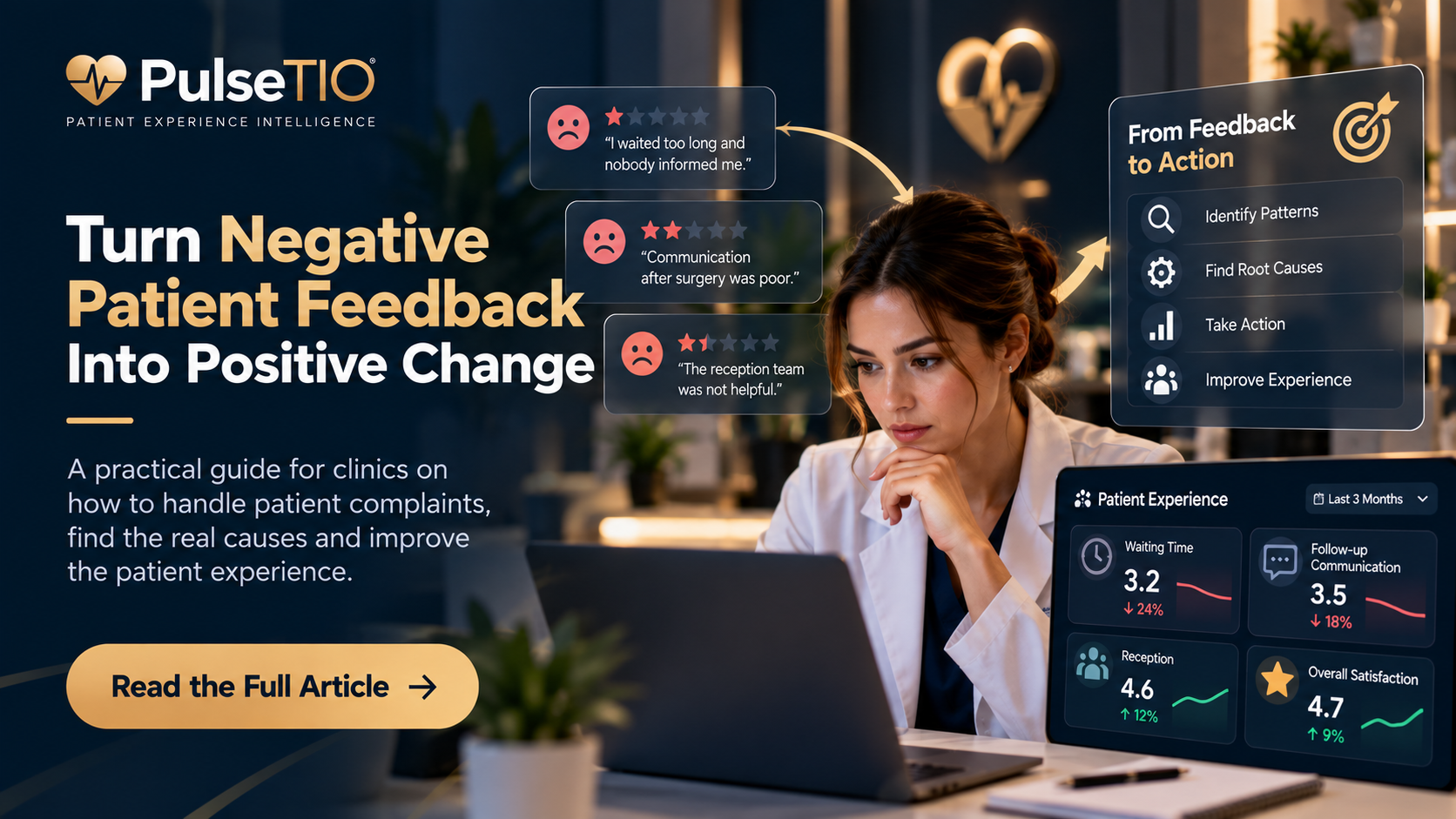
How to Handle Negative Patient Feedback: A Practical Guide for Clinics
Negative patient feedback can reveal communication, operational and safety problems clinics may otherwise miss. Learn how to respond, identify patterns and turn complaints into patient experience improvements.
Nobody likes receiving negative patient feedback.
A low satisfaction score appears.
A patient writes:
“The doctor was excellent, but I waited too long and nobody explained what was happening.”
Or:
“I sent three messages after my procedure and it took too long to receive a response.”
The natural reaction is often defensive.
Was the complaint fair?
Was the clinic actually responsible?
Is the patient exaggerating?
But those are rarely the most useful first questions.
A better question is:
What can this feedback tell us about the patient journey?
Because negative patient feedback is not simply a reputation problem.
Handled correctly, it can become one of the most valuable sources of operational intelligence available to a clinic.
Research supports this.
A major systematic review analyzed 59 studies containing 88,069 patient complaints and identified more than 113,000 individual issues. Complaints revealed problems relating not only to treatment, but also communication, organizational management and staff–patient relationships.
More recently, a 2026 review in BMJ Quality & Safety examined how healthcare organizations have actually used complaint data for quality improvement.
The conclusion is increasingly difficult to ignore:
Patient complaints should not simply be answered. They should be analyzed.
Negative Feedback Is Often an Early Warning System
Consider two clinics.
Clinic A
A patient waits 55 minutes.
Nobody explains the delay.
The patient becomes frustrated but says nothing.
Two weeks later, they leave a two-star Google review.
The clinic discovers the problem publicly.
Clinic B
The same patient receives a short feedback request after the visit.
They rate waiting time:
2 / 5
and write:
“I understand doctors can run late. I just wish someone had told me.”
The clinic discovers the problem privately and almost immediately.
Same experience.
Completely different visibility.
That difference is important.
A structured patient feedback system gives clinics an opportunity to detect friction before their only source of information becomes a public review or formal complaint.
It does not mean suppressing negative reviews.
It means giving patients a clear channel to tell the clinic what happened.
What Do Patients Actually Complain About?
Patient complaints are often dismissed as isolated emotional reactions.
Large-scale research suggests otherwise.
The systematic review of 88,069 patient complaints found that the most frequently identified individual issues included:
Treatment — 15.6%
Communication — 13.7%
When researchers grouped more than 113,000 complaint issues into broader domains, they found that complaints were distributed across:
Clinical care quality and safety — 33.7%
Healthcare organization management — 35.1%
Staff–patient relationships — 29.1%
In other words, negative patient experiences are not exclusively about whether the medical treatment was successful.
A very large proportion concerns how healthcare is delivered.
This includes things such as:
poor communication
delays
access problems
staff attitude
coordination
administrative processes
respect
information
expectations
These are precisely the areas clinics can often improve.
A Complaint Is Different From a Pattern
One negative response does not necessarily mean your clinic has a systemic problem.
Patients have different expectations.
Situations differ.
Unexpected delays happen.
Misunderstandings occur.
But imagine receiving:
1 complaint about waiting time
That is worth reviewing.
Now imagine:
27 patients mentioning waiting time during the same month.
That is no longer an isolated complaint.
It is data.
And this distinction is fundamental to patient experience management.
Clinics should avoid reacting dramatically to every individual score.
Instead, they should ask:
Is this isolated?
Or is this recurring?
The Wrong Way to Handle Negative Patient Feedback
Several common reactions reduce the value of feedback.
1. Immediately Defending the Clinic
The team begins explaining why the patient is wrong.
Perhaps the physician was dealing with an emergency.
Perhaps the patient arrived early.
Perhaps the coordinator already sent the instructions.
All of that may be true.
But before explaining what happened, understand what the patient experienced.
Intent and experience are not always the same.
2. Looking Only at the Overall Score
Suppose your clinic has:
Overall Satisfaction: 4.7 / 5
Excellent.
But underneath:
Doctor Communication: 4.9
Reception: 4.8
Facility: 4.8
Waiting Time: 3.4
Follow-Up: 3.6
The average can make the organization feel comfortable while hiding operational weaknesses.
3. Treating Every Complaint as a Reputation Threat
A negative response is not necessarily bad for the clinic.
It can be useful.
The real risk is repeatedly receiving the same complaint without recognizing it.
4. Trying to Prevent Negative Patients From Speaking Publicly
This deserves particular attention.
Patient experience management should not become:
Happy patient → Ask for Google review
Unhappy patient → Prevent review
That becomes review gating.
The objective of collecting private feedback should be to understand and improve the experience, not suppress genuine criticism.
A healthier model is:
Collect → Understand → Respond → Improve → Measure again
Step 1: Respond to the Patient, Not the Score
If a patient reports a genuinely poor experience, the first objective should be understanding.
Not NPS.
Not the dashboard.
Not Google ratings.
The patient.
A useful response process starts with:
Acknowledgement
Show that the feedback has been received.
Clarification
Understand exactly what happened.
Investigation
Check the operational or clinical context where necessary.
Resolution
Determine whether something can reasonably be corrected.
Follow-up
Close the loop with the patient when appropriate.
The response should be proportional to the problem.
A 15-minute delay and a potentially serious clinical concern obviously require different escalation pathways.
Step 2: Categorize the Feedback
Free-text comments become much more valuable when they are categorized.
For example:
Communication
unclear instructions
unanswered messages
insufficient explanation
language difficulties
Waiting Time
doctor delay
check-in delay
treatment delay
lack of information about delay
Reception
attitude
administrative process
payment
appointment management
Clinical Experience
consultation
explanation
perceived quality
treatment concerns
Follow-Up
slow response
unclear recovery instructions
difficulty reaching the clinic
Facility
comfort
cleanliness
privacy
accessibility
Now complaints can be aggregated.
Instead of seeing 100 disconnected comments, management might discover:
31% of negative feedback this month relates to postoperative communication.
That is actionable.
Step 3: Look for Frequency, Severity and Recurrence
Not every issue deserves equal attention.
A useful patient experience system should help clinics evaluate three things.
Frequency
How often is the issue occurring?
If waiting time appears repeatedly, there may be an operational pattern.
Severity
How serious is the problem?
One serious safety-related report may be more important than twenty comments about parking.
Recurrence
Has this happened before?
A complaint that keeps returning after attempted improvements suggests the intervention has not worked.
This is where simply reading comments becomes insufficient.
The clinic needs structured data.
Step 4: Identify the Root Cause
The first explanation is not always the real problem.
Consider this feedback:
“I waited too long.”
The obvious solution seems to be:
Reduce waiting time.
But investigation may reveal:
The actual waiting time was 25 minutes.
Patients normally tolerate that.
The problem was that the reception team told them:
“The doctor will see you in five minutes.”
Twenty minutes later, nobody had provided an update.
The root problem is therefore not necessarily scheduling.
It may be expectation management and communication.
That distinction determines the solution.
Step 5: Turn Feedback Into an Operational Change
Feedback creates value only when something changes.
Suppose patients repeatedly report difficulty reaching the clinic after surgery.
The clinic investigates and discovers that all postoperative WhatsApp messages go into the same general inbox used for new patient enquiries.
Possible intervention:
Create a priority follow-up channel for postoperative patients.
Then measure follow-up satisfaction again.
That creates a cycle:
Feedback → Insight → Change → Measurement
Without the final measurement, you still do not know whether the change worked.
Does Acting on Patient Feedback Actually Improve Experience?
There is evidence that it can.
A systematic review of hospital quality-improvement interventions identified 21 studies involving interventions designed to improve patient experience.
Twenty of the 21 studies reported improvements in patient experience measures, and 14 reported statistically significant improvements.
Interventions included:
staff education
patient education
audit and feedback
clinician reminders
organizational changes
policy changes
The review also highlighted an important reality:
Simply collecting data is insufficient.
Organizational engagement and the ability to translate findings into change are critical.
What Does the Latest Research Say About Complaints?
A newer 2026 scoping review in BMJ Quality & Safety specifically examined healthcare quality-improvement initiatives that used patient complaint material.
Researchers identified 58 quality-improvement initiatives.
Safety was the most commonly targeted area.
Before interventions, complaint information was analyzed through methods such as:
case review
complaint counts
content categorization
root-cause analysis
Among studies that used complaints as an outcome after quality-improvement initiatives:
43 reported reductions in complaints
2 reported increases
4 reported mixed findings
The authors appropriately caution that these findings should not automatically be interpreted as proof of causation.
But the overall picture supports the practical value of treating complaint data as a source for identifying and monitoring healthcare improvement opportunities.
Patient Complaints Can Reveal Problems Other Systems Miss
One particularly important insight from complaint research is that patients see healthcare from a different perspective than internal quality systems.
Incident reporting systems may detect:
medication errors
clinical incidents
procedural problems
Patients may detect:
dignity problems
poor communication
confusing processes
coordination failures
disrespect
access difficulties
These problems may never appear in traditional safety reports.
Researchers studying healthcare complaints have therefore described complaint data as a potentially distinctive source of information about quality and safety “blind spots.”
That is why feedback should not be treated merely as a customer-service function.
It can be an operational intelligence source.
The Most Valuable Negative Feedback May Be the Feedback You Never Receive
There is another problem.
Not every dissatisfied patient complains.
Some simply leave.
Some choose another clinic next time.
Some tell friends.
Some write a review months later.
Some do nothing.
This creates a dangerous illusion:
No complaints = everyone is satisfied.
That conclusion is not justified.
Formal complaints represent only one channel.
A mature patient experience strategy creates easier opportunities for patients to provide feedback before dissatisfaction reaches that level.
For example:
How was your experience today?
takes seconds to answer.
That simple invitation can uncover information a clinic might otherwise never receive.
Negative Feedback Should Be Compared With Positive Feedback
There is another common analytical mistake:
Looking only at dissatisfied patients.
Positive patient feedback also contains operational intelligence.
Suppose patients repeatedly praise:
physician explanations
international patient coordinators
postoperative communication
These are organizational strengths.
The objective of patient experience management is therefore not simply:
Find what is wrong.
It is:
Understand what consistently creates good and bad experiences.
Then protect what works and improve what does not.
What Should Trigger Immediate Attention?
Clinics should define escalation rules.
Certain types of feedback deserve rapid review regardless of frequency.
Examples may include:
potential patient safety concerns
serious communication failures
allegations of inappropriate behavior
privacy concerns
significant treatment-related concerns
repeated postoperative contact failures
severe dissatisfaction following an intervention
Other issues may be monitored as trends.
For example:
parking
refreshments
minor facility concerns
A feedback system becomes more useful when it helps separate:
urgent
from
important
from
informational.
The Feedback Loop Every Clinic Should Build
A practical patient feedback loop can be summarized in six stages.
1. Capture
Ask patients about their experience after meaningful interactions.
2. Categorize
Understand whether feedback relates to:
communication, waiting, reception, treatment, follow-up or another category.
3. Detect
Identify poor scores, recurring themes and unusual changes.
4. Respond
Address individual cases when appropriate.
5. Improve
Make operational changes based on meaningful patterns.
6. Measure Again
Determine whether the change actually improved the experience.
Then repeat.
That is a feedback loop.
A survey alone is not.
Why Real-Time Visibility Matters
Imagine discovering in October that follow-up satisfaction has been declining since July.
By then, hundreds of patients may have experienced the same issue.
Now imagine identifying the decline after the first two weeks.
That creates a very different opportunity.
Patient experience data becomes substantially more valuable when clinics can see:
what is changing now.
Not months later.
For private clinics operating in competitive markets, this can be particularly important.
Patients have choices.
Poor experiences accumulate.
And digital reputation increasingly makes those experiences visible.
How PulseTIO Helps Clinics Manage Negative Feedback
PulseTIO is designed to make patient feedback structured and measurable.
Clinics can collect experience data after meaningful patient interactions and measure areas such as:
overall satisfaction
NPS
communication
reception
waiting time
hospitality
follow-up
customized experience categories
Patients can also provide qualitative comments explaining their scores.
Instead of seeing isolated feedback, clinics can monitor trends through a centralized dashboard.
That means moving from:
“A patient complained about waiting.”
to:
“Waiting-time satisfaction has declined during the past four weeks and represents the most common source of negative feedback.”
The first is a complaint.
The second is intelligence.
The Goal Is Not Zero Negative Feedback
A clinic receiving no negative feedback is not necessarily delivering a perfect experience.
It may simply not be asking.
Patients have different expectations.
Problems happen.
Healthcare is complex.
The goal should therefore not be:
Eliminate every negative comment.
The better objective is:
Detect meaningful problems earlier.
Understand why they happen.
Respond appropriately.
Prevent recurring issues where possible.
Measure whether the experience improves.
Because the most dangerous patient complaint is not always the harshest one.
It may be the complaint your organization receives repeatedly — but never recognizes as a pattern.
Listen early.
Understand the pattern.
Fix what matters.
Measure again.
Frequently Asked Questions
Common questions and answers regarding this topic.
Q.How should a clinic respond to negative patient feedback?
A clinic should first acknowledge and understand the feedback, investigate the situation when necessary, respond proportionately, and determine whether the issue represents an isolated case or a recurring patient experience problem.
Q.Why is negative patient feedback important?
Negative feedback can reveal communication, organizational, relationship and clinical issues that may not appear in other healthcare quality monitoring systems. Large systematic reviews have found patient complaints contain substantial information about all of these areas.
Q.Should every negative patient comment trigger a change?
No. Individual feedback should be reviewed, but operational decisions are generally stronger when clinics consider frequency, severity, recurrence and context.
Q.What are the most common reasons patients complain?
A systematic review of 88,069 patient complaints found treatment and communication among the most common individual complaint categories, while broader issues were distributed across clinical care, healthcare management and staff–patient relationships.
Q.Can patient complaints improve healthcare quality?
They can contribute to improvement when systematically analyzed and connected to quality-improvement processes. A 2026 scoping review identified 58 quality-improvement initiatives using complaint material; among studies using complaints as an outcome, most reported reductions following interventions, although the authors caution against interpreting this as definitive causal evidence.
Q.What is the difference between a patient complaint and patient feedback?
Patient feedback includes positive, neutral and negative information collected through surveys, ratings, comments and other channels. A formal complaint is typically a more specific expression of dissatisfaction and may involve a defined organizational response process.