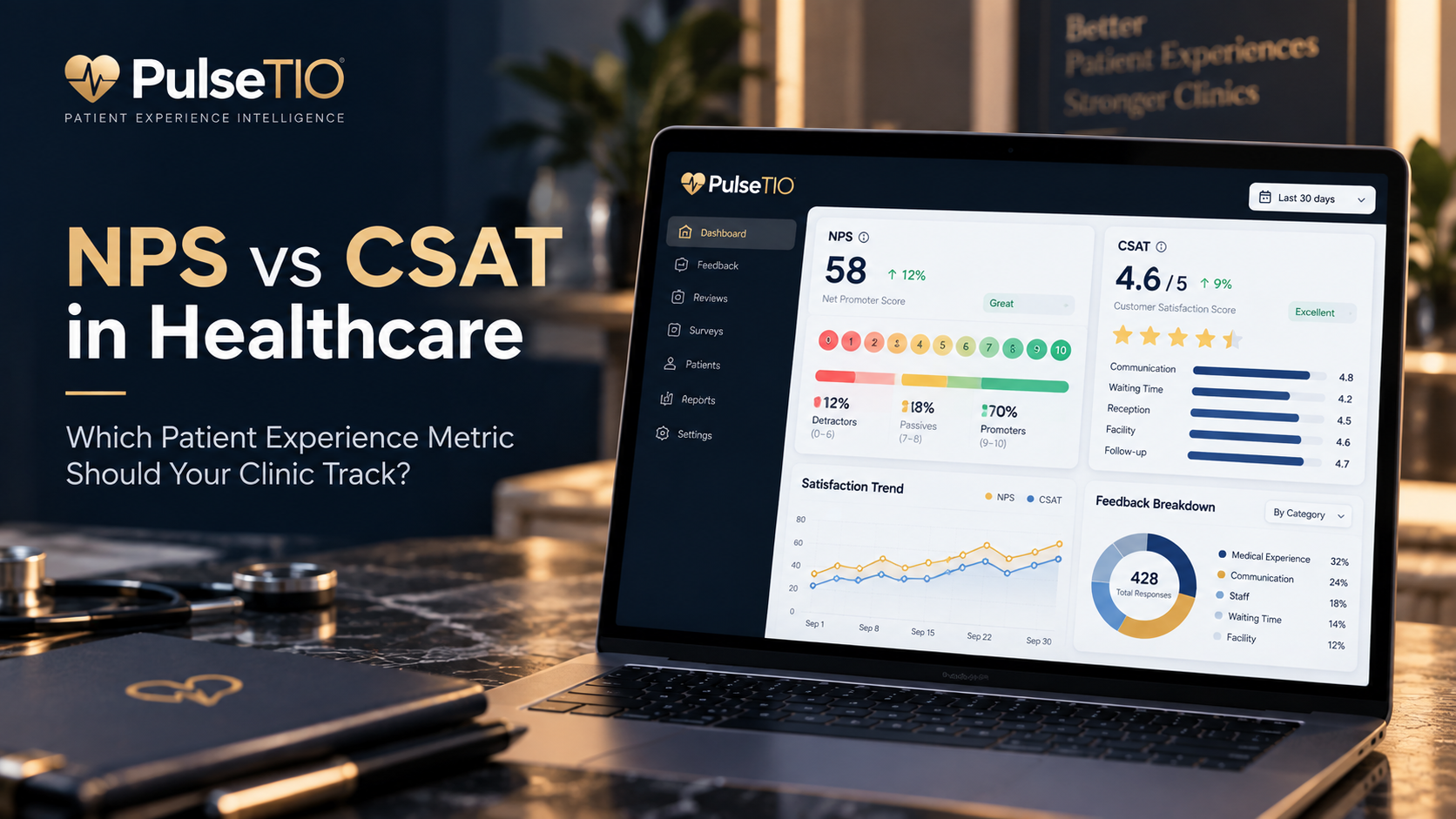
NPS vs CSAT in Healthcare: Which Patient Experience Metric Should Your Clinic Track?
Understand the difference between NPS and CSAT in healthcare, when clinics should use each metric, and how to turn patient feedback into actionable experience intelligence.
A clinic can receive excellent Google reviews and still have problems in parts of the patient journey.
It can also have a high satisfaction score while patients remain unlikely to recommend it.
This is why measuring patient experience with a single number can be misleading.
Two of the most commonly used metrics are NPS (Net Promoter Score) and CSAT (Customer Satisfaction Score).
Both are useful.
But they answer different questions.
For clinics, the real value comes from understanding when to use each metric, what the score actually tells you, and what it does not tell you.
What Is NPS in Healthcare?
NPS — Net Promoter Score — measures a patient's likelihood of recommending your clinic, practice or healthcare organization to someone else.
The standard question is:
“How likely are you to recommend our clinic to a friend or family member?”
Patients typically answer on a scale from 0 to 10.
Responses are divided into three groups:
Promoters — 9 or 10
Patients who are highly likely to recommend the clinic.
Passives — 7 or 8
Patients who are generally satisfied but may not feel strongly enough to actively recommend the clinic.
Detractors — 0 to 6
Patients who are less likely to recommend the clinic and may have experienced problems during their journey.
The NPS calculation is:
NPS = % of Promoters − % of Detractors
The result can range from -100 to +100.
For example:
If 65% of patients are promoters and 15% are detractors:
NPS = 65 − 15 = 50
But the number itself is only the beginning.
The most important question is:
Why did the patient give that score?
What Does NPS Tell a Clinic?
NPS is primarily a relationship and loyalty indicator.
It can help answer questions such as:
Would patients recommend the clinic?
Is overall patient advocacy improving?
Are more patients becoming promoters over time?
Has a change in the patient journey affected loyalty?
Are certain locations, doctors or services producing different recommendation patterns?
For clinic managers, NPS becomes particularly useful when it is monitored as a trend.
A single month's score may not reveal much.
But if NPS moves from 58 to 41 over several months, something may have changed in the patient experience.
The score creates the signal.
The underlying feedback explains the reason.
What Is CSAT in Healthcare?
CSAT — Customer Satisfaction Score — measures how satisfied a patient is with a specific interaction or experience.
A typical question might be:
“How satisfied were you with your visit today?”
Patients may respond using a scale such as:
1 — Very dissatisfied
2 — Dissatisfied
3 — Neutral
4 — Satisfied
5 — Very satisfied
CSAT is commonly calculated using the percentage of patients selecting one of the positive responses.
For example:
If 84 out of 100 patients select “Satisfied” or “Very satisfied,” the clinic's CSAT would be:
84%
Unlike NPS, CSAT is especially useful for evaluating individual touchpoints.
What Can Clinics Measure With CSAT?
A clinic does not need to limit CSAT to the entire appointment.
It can measure satisfaction with individual parts of the patient journey.
For example:
Appointment scheduling
How satisfied was the patient with the booking process?
Reception
How satisfied was the patient with the welcome and administrative process?
Waiting time
How satisfied was the patient with the amount of time they waited?
Doctor communication
Did the patient feel informed and listened to?
Treatment information
Were the instructions clear?
Follow-up
Was the patient satisfied with communication after the visit or procedure?
International patient coordination
Were travel, translation, transfer or accommodation processes clear?
This creates a more detailed picture than simply asking:
“Were you satisfied?”
NPS vs CSAT: What Is the Difference?
The simplest way to understand the difference is this:
NPS measures advocacy.
CSAT measures satisfaction.
NPS asks whether the overall relationship is strong enough for the patient to recommend the clinic.
CSAT asks whether a particular experience met the patient's expectations.
They can therefore produce very different insights.
Consider this example:
A patient may be very satisfied with the doctor's consultation.
Doctor consultation CSAT: 5/5
But the same patient may have waited 70 minutes, struggled to contact the clinic before the appointment and received unclear follow-up instructions.
When asked whether they would recommend the clinic:
NPS response: 6/10
The medical interaction was excellent.
The overall patient journey was not.
If the clinic only measured consultation satisfaction, it might never discover the broader problem.
NPS and CSAT Should Not Compete
Clinics sometimes ask:
“Should we use NPS or CSAT?”
In most cases, that is the wrong question.
A better question is:
“Where in the patient journey should we use each metric?”
They work best together.
For example:
After a consultation
Use CSAT to measure the immediate experience.
After a treatment or procedure
Use CSAT to understand specific aspects such as communication, comfort and staff experience.
After the overall patient journey
Use NPS to understand whether the patient would recommend the clinic.
This gives the clinic both:
touchpoint-level insight
and
relationship-level insight.
A High NPS Does Not Mean Everything Is Working
One of the biggest mistakes in patient experience measurement is treating a strong headline score as proof that the entire system is performing well.
Imagine a clinic with:
NPS: 72
That appears excellent.
But a deeper analysis could show:
Doctor communication: 96% satisfaction
Reception: 89%
Clinic environment: 94%
Waiting time: 61%
Post-treatment communication: 68%
The clinic has strong patient advocacy overall.
But it also has two clear operational weaknesses.
If management only looks at NPS, those problems can remain hidden.
This is why experience data should be segmented.
A High CSAT Does Not Always Mean Patients Will Recommend You
The opposite can also happen.
A clinic may receive consistently high satisfaction ratings for individual interactions.
Patients may describe staff as friendly.
The environment may be excellent.
Appointments may run smoothly.
But patients may still hesitate to recommend the clinic because of:
unclear pricing
poor follow-up
inconsistent communication
difficult scheduling
unmet expectations
problems that occurred later in the journey
CSAT measures moments.
NPS reflects the broader relationship.
Neither tells the complete story alone.
The Missing Layer: Qualitative Feedback
Numbers tell you what is happening.
Patient comments often tell you why.
This is why every important score should ideally be followed by an opportunity to provide context.
For example:
How satisfied were you with your visit today?
4/5
Then:
What could we have done better?
“Everything was good, but I waited almost 45 minutes without being told about the delay.”
The score is useful.
The comment makes it actionable.
Without qualitative feedback, clinic managers may see fluctuations without understanding what caused them.
Measure the Patient Journey, Not Just the Final Score
Patient experience does not happen at one moment.
It is the result of many interactions.
A typical clinic journey may include:
Finding the clinic
Making first contact
Scheduling
Pre-visit communication
Arrival
Reception
Waiting
Consultation
Treatment or procedure
Payment
Post-treatment instructions
Follow-up
Ongoing communication
A patient may rate these stages very differently.
That creates an important distinction:
Overall satisfaction is an outcome.
Patient journey data helps explain that outcome.
For clinics trying to improve operations, the second is often more valuable.
How Often Should Clinics Measure NPS and CSAT?
There is no single schedule that works for every clinic.
The timing should match the patient journey.
CSAT
CSAT works best close to the interaction being measured.
Examples include:
immediately after a consultation
after a procedure
after discharge
after customer support interaction
after a follow-up appointment
The experience is still fresh, making the feedback more specific.
NPS
NPS is generally more useful after the patient has experienced enough of the journey to evaluate the clinic as a whole.
For example:
after treatment
after a completed care episode
during follow-up
after an international patient returns home
Asking too early may measure only one interaction rather than the complete relationship.
Avoid Survey Fatigue
More measurement does not automatically create better intelligence.
If patients receive a survey after every minor interaction, response rates may decline and the feedback can become less meaningful.
Clinics should focus on important moments.
A useful principle is:
Ask fewer questions, but ask them at the right time.
A short survey that takes 30 seconds to complete may generate better feedback than a long questionnaire patients abandon halfway through.
Segment Your Patient Experience Data
An overall clinic average can hide important differences.
When possible, patient experience data should be analyzed by relevant segments.
These could include:
location
physician
treatment
procedure
patient journey stage
local vs international patient
language
new vs returning patient
time period
For example, a clinic might discover that its overall NPS is stable while satisfaction among international patients has declined.
Or that one procedure generates excellent clinical satisfaction but weaker post-treatment communication scores.
Segmentation turns feedback into operational intelligence.
What Metrics Should a Clinic Dashboard Include?
A useful patient experience dashboard should not become a wall of numbers.
It should answer a few important questions quickly:
How satisfied are patients?
Track overall CSAT and relevant category scores.
Would they recommend us?
Monitor NPS and the distribution of promoters, passives and detractors.
Where are problems occurring?
Track low-scoring categories and recurring feedback themes.
Is performance improving?
Compare results over time.
What are patients actually saying?
Combine numerical data with qualitative feedback.
Are we collecting enough data?
Monitor response volume and survey completion rates.
The objective is not to measure everything.
It is to identify what requires attention.
From Patient Metrics to Patient Experience Intelligence
Collecting NPS and CSAT is relatively easy.
The difficult part is turning those scores into decisions.
A clinic needs to understand:
what changed
where it changed
why it changed
whether the issue is isolated or recurring
what action should follow
whether that action improved the experience
That is where patient experience measurement becomes patient experience intelligence.
Instead of seeing:
CSAT: 82%
a clinic should be able to understand:
Waiting-time satisfaction dropped 11% this month, while all other experience categories remained stable.
That is something a management team can act on.
How PulseTIO Uses NPS and CSAT
PulseTIO is designed to help clinics collect structured feedback across the patient journey and turn it into measurable experience data.
Clinics can create customizable feedback flows using different question types and measure areas such as:
overall satisfaction
NPS
reception experience
communication
hospitality
waiting time
treatment journey
follow-up experience
Feedback can then be monitored through a central dashboard so teams can identify trends rather than relying on isolated comments.
For clinics treating international patients, multilingual survey flows can also make it easier to collect feedback from different patient groups in the language they are most comfortable using.
The objective is not to chase a perfect score.
It is to understand the patient journey well enough to improve it.
Which Metric Should Your Clinic Use?
If you want to understand satisfaction with a specific experience, use CSAT.
If you want to understand whether patients would recommend your clinic, use NPS.
If you want to understand and improve the entire patient journey, use both — alongside category-specific questions and qualitative feedback.
Because the most useful question is rarely:
“What is our score?”
It is:
“What is driving our score, and what should we improve next?”
That is the difference between collecting feedback and actually using it.
Frequently Asked Questions
Common questions and answers regarding this topic.
Q.What is NPS in healthcare?
NPS, or Net Promoter Score, measures how likely a patient is to recommend a clinic or healthcare provider. Patients answer on a 0–10 scale and are grouped as promoters, passives or detractors.
Q.What is CSAT in healthcare?
CSAT, or Customer Satisfaction Score, measures satisfaction with a specific interaction, such as a consultation, treatment, reception experience or follow-up.
Q.Is NPS or CSAT better for clinics?
Neither is universally better. CSAT is more useful for measuring individual patient journey touchpoints, while NPS provides a broader indication of recommendation and patient advocacy. Clinics can gain more insight by using both.
Q.How often should clinics measure patient satisfaction?
CSAT should generally be collected soon after the interaction being measured. NPS is better used after patients have experienced enough of the overall journey to evaluate the clinic more broadly.
Q.Can a clinic have high CSAT but low NPS?
Yes. Patients may be satisfied with individual interactions but still hesitate to recommend the clinic because of problems elsewhere in the journey, such as scheduling, waiting time, pricing communication or follow-up.
Q.What patient experience metrics should clinics track?
Useful metrics include NPS, CSAT, category-specific satisfaction scores, qualitative patient comments, survey response rates and trends across different stages of the patient journey.