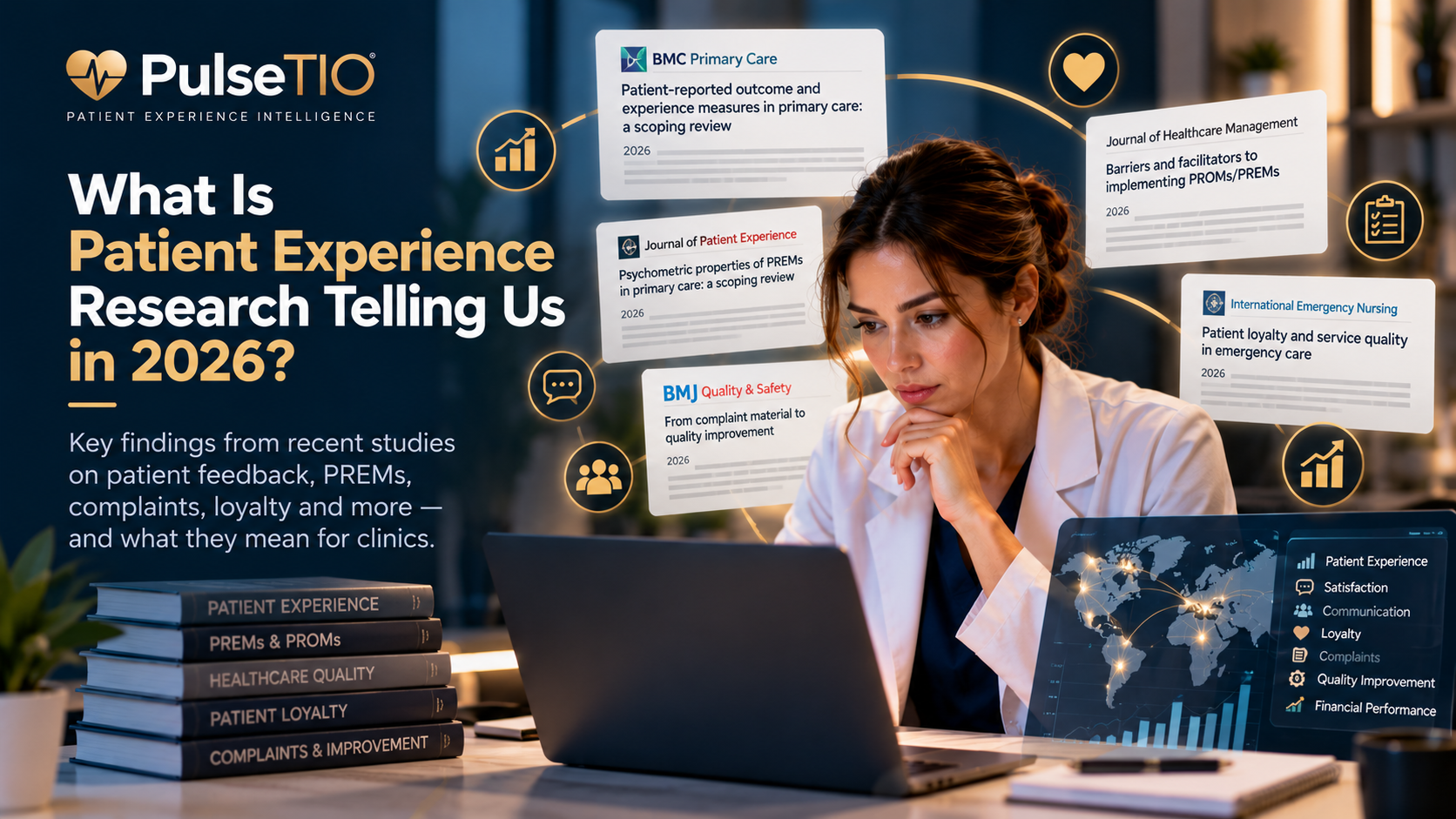
Patient Experience Research in 2026: What Recent Studies Are Telling Clinics
What is recent research telling us about patient experience? Explore new 2026 studies on PREMs, patient feedback, complaints, healthcare quality and patient loyalty.
Patient experience is moving beyond satisfaction surveys.
Recent research increasingly treats patient feedback, Patient-Reported Experience Measures (PREMs), complaints, communication and loyalty as data that healthcare organizations can use to understand how care is actually experienced — and where it needs to improve.
For clinics and hospitals, this represents an important shift.
The question is no longer simply:
“Are our patients satisfied?”
It is becoming:
“What can patient-reported experience data tell us about the way our organization works?”
Several studies published in 2026 help answer that question.
And together, they point toward the same conclusion:
Collecting feedback is not enough. Healthcare organizations need systems capable of turning patient feedback into operational intelligence.
1. PREMs Are Becoming Part of Healthcare Infrastructure
A February 2026 scoping review examined how Patient-Reported Outcome Measures (PROMs) and Patient-Reported Experience Measures (PREMs) are being systematically collected and used in primary care.
Researchers screened 3,762 records, reviewed 211 full-text publications and ultimately identified 18 programmes meeting their criteria.
The programmes were being used for several different purposes, including:
clinical care
quality improvement
performance monitoring
benchmarking
equity monitoring
accountability
One of the most interesting findings was what allowed these programmes to work.
Successful implementation was associated with factors such as:
clear governance
sustained funding
integration with electronic health records or data repositories
continued engagement from clinicians and patients
PREMs most commonly measured areas such as:
access, communication, continuity and person-centredness.
The message for clinics is significant.
Patient experience measurement is increasingly becoming an operational infrastructure, rather than an occasional survey exercise.
Patient-reported outcome and experience measures in primary care: a scoping review of systematic collection and use
PMID: 41645212 — DOI: 10.1186/s12913-026-14127-8.
2. There Is Still No Single Perfect Patient Experience Survey
Another 2026 scoping review examined the psychometric properties of PREMs specifically developed for primary care.
The researchers identified 23 different patient-reported experience measures.
What they found is important.
Patient experience was not consistently defined across the instruments.
The most common areas measured included:
accessibility
relational aspects of care
quality of clinical care and services
But no single instrument covered every relevant patient experience construct.
Survey length also varied dramatically — from 4 to 74 questions.
Perhaps even more importantly, only five of the identified tools involved patients in their development.
This raises an important question for clinics:
Should every healthcare organization use exactly the same questionnaire?
Probably not.
A dental clinic, plastic surgery clinic, ophthalmology practice and large hospital do not necessarily have the same patient journey.
The evidence increasingly supports measuring the experience that actually matters in the specific healthcare environment.
Psychometric properties and constructs of Patient Reported Experience Measures (PREMs) in primary care: a scoping review
PMID: 42374222 — DOI: 10.1186/s12875-026-03436-w.
3. The Biggest Challenge Is Not Collecting Data — It Is Using It
This may be one of the most important developments in recent patient experience research.
A newly published overview of systematic reviews examined barriers and facilitators to implementing PROMs and PREMs across healthcare systems.
Researchers analyzed 32 systematic reviews, producing 1,326 implementation-factor mentions across 44 constructs.
Several recurring barriers emerged.
Patients may struggle to complete measures because of:
language
health literacy
illness or disability
limited digital access
Healthcare organizations also face problems such as:
poor integration with clinical workflows
weak integration with information systems
surveys that are too long or difficult to use
complex interpretation processes
limited clinician motivation to use the results
But the facilitators are equally revealing.
Successful implementation was supported by:
user-centred design
clear clinical usefulness
reliable IT infrastructure
integration into existing workflows
timely review and follow-up
patients believing the questions were meaningful
This changes the way we should think about patient feedback software.
The objective should not simply be:
Send more surveys.
It should be:
Make feedback easy to give, easy to understand and easy to act on.
Barriers and facilitators to implementing patient-reported outcome and experience measures in health systems: a comprehensive overview of systematic reviews.
4. Complaints Are Becoming a Quality-Improvement Dataset
Patient complaints have traditionally been treated as individual cases.
Receive complaint.
Respond to patient.
Close complaint.
But recent research suggests healthcare organizations can extract much more value from them.
A 2026 BMJ Quality & Safety scoping review identified 58 quality-improvement initiatives that used complaints or compensation claims as part of improvement programmes.
Safety was the most frequently targeted area.
Organizations analyzed complaint information through methods including:
case review
complaint counts
content categorization
root-cause analysis
Among studies that subsequently used complaints as an outcome measure, 43 reported reductions in complaints, while two reported increases and four reported mixed findings.
The authors appropriately caution that these results do not prove that the interventions directly caused those reductions.
Nevertheless, the study illustrates something extremely important:
Complaints become much more valuable when organizations stop treating them as isolated events and start looking for patterns.
From complaint material to quality improvement: Exploring the use of patient complaints or compensation claims in quality improvement initiatives — a scoping review
PMID: 40780822 — DOI: 10.1136/bmjqs-2025-018780.
5. Patient Experience Can Also Influence Loyalty
Patient experience research is also moving closer to questions traditionally associated with healthcare growth.
A 2026 study published in International Emergency Nursing investigated the relationship between service quality and patient loyalty.
Researchers collected data from 199 emergency department patients.
Medical service quality was significantly associated with both:
intention to revisit
word-of-mouth intention
Interestingly, first-time and returning patients behaved differently.
First-time patients showed stronger word-of-mouth intention, while returning patients demonstrated stronger revisit intention.
This distinction matters.
Healthcare organizations often treat “patient loyalty” as one concept.
In reality, a positive experience may generate different behaviors:
Return to the clinic.
Recommend the clinic.
Share the experience with someone else.
These are different outcomes, and patient experience can contribute to all of them.
Patient loyalty in the emergency department: An extended SERVPERF approach comparing first-visit and return patients
PMID: 42066722 — DOI: 10.1016/j.ienj.2026.101832.
6. Technology Matters — But Integration Matters More
Another emerging research theme is how patient-reported data fit into healthcare information systems.
Simply putting a survey online does not solve the problem.
Patient feedback becomes much more useful when it connects with context.
For example:
Which visit?
Which location?
Which physician?
Which procedure?
Which stage of the patient journey?
Which language?
A 2026 scoping review specifically examined health information systems integrating patient-reported outcomes and experience measures, reflecting the growing focus on making these datasets part of healthcare information infrastructure rather than keeping them in isolated survey systems.
For modern clinics, this is an important distinction.
A form collects answers.
A patient experience system creates context.
So What Is Recent Research Actually Telling Us?
Looking across these studies, several themes appear repeatedly.
Patient experience is multidimensional.
There is no single question capable of explaining the entire healthcare journey.
Shorter is not automatically better — and longer is not automatically better.
The questions need to match the experience being measured.
Feedback must fit into workflow.
A survey nobody reviews has almost no operational value.
Qualitative feedback matters.
Scores tell organizations what changed.
Patient comments often explain why.
Complaints should be aggregated.
One complaint is a case.
Twenty complaints about the same issue may reveal a system problem.
Technology needs context.
Feedback becomes significantly more valuable when it can be connected to visits, physicians, locations, procedures and stages of care.
Patient experience can influence behavior.
Research continues to connect healthcare service quality and experience with recommendation and revisit intention.
That makes patient experience relevant not only to quality teams, but also to leadership, operations and growth.
From Patient Feedback to Patient Experience Intelligence
The direction of current research is increasingly clear.
Healthcare organizations do not simply need more patient data.
They need the ability to transform that data into something useful.
Imagine knowing:
Overall Satisfaction: 4.6 / 5
That is useful.
But imagine knowing:
Overall Satisfaction: 4.6 / 5
Doctor Communication: 4.9
Reception: 4.7
Waiting Time: 3.5
Follow-Up: 3.6
And then discovering that follow-up scores have declined for three consecutive weeks among international patients.
That is no longer just feedback.
That is patient experience intelligence.
Why PulseTIO Is Building a Research & Evidence Library
Patient experience technology should not be built only around assumptions.
It should be informed by what healthcare research is actually discovering.
That is why we created the PulseTIO Patient Experience Research & Evidence Library.
It brings together scientific studies covering areas such as:
patient experience
patient feedback
PREMs
patient satisfaction
communication
complaints
NPS and CSAT
loyalty and retention
reputation
quality improvement
healthcare operations
financial performance
Each entry includes the original study information and source so healthcare professionals can explore the evidence directly.
Explore Patient Experience Research & Evidence →
https://www.pulsetio.com/research
We will continue expanding the library as new evidence is published.
Because the future of patient experience should not be built on assumptions.
It should be built on evidence.
Frequently Asked Questions
Common questions and answers regarding this topic.
Q.What does recent research say about patient experience?
Recent studies increasingly show that patient experience should be measured across multiple dimensions including access, communication, continuity, relationships and service quality rather than through a single satisfaction score. PubMed
Q.What are PREMs?
Patient-Reported Experience Measures (PREMs) are structured tools used to capture patients' experiences of healthcare, including areas such as communication, accessibility, continuity and person-centred care.
Q.Can patient complaints be used to improve healthcare quality?
Yes. A 2026 scoping review identified 58 quality-improvement initiatives using complaints or compensation claims as sources of information for healthcare improvement, although the authors caution against interpreting observed reductions in complaints as definitive causal evidence. PubMed
Q.Does patient experience affect patient loyalty?
Evidence suggests healthcare service quality and patient experience can be associated with behaviors such as intention to return and word-of-mouth recommendation. A 2026 emergency-department study of 199 patients found significant relationships between service quality and both revisit and recommendation intentions.
Q.Why should clinics collect patient feedback systematically?
Systematic feedback allows healthcare organizations to identify trends across communication, access, waiting, follow-up and other parts of the patient journey instead of relying on isolated comments or public reviews.