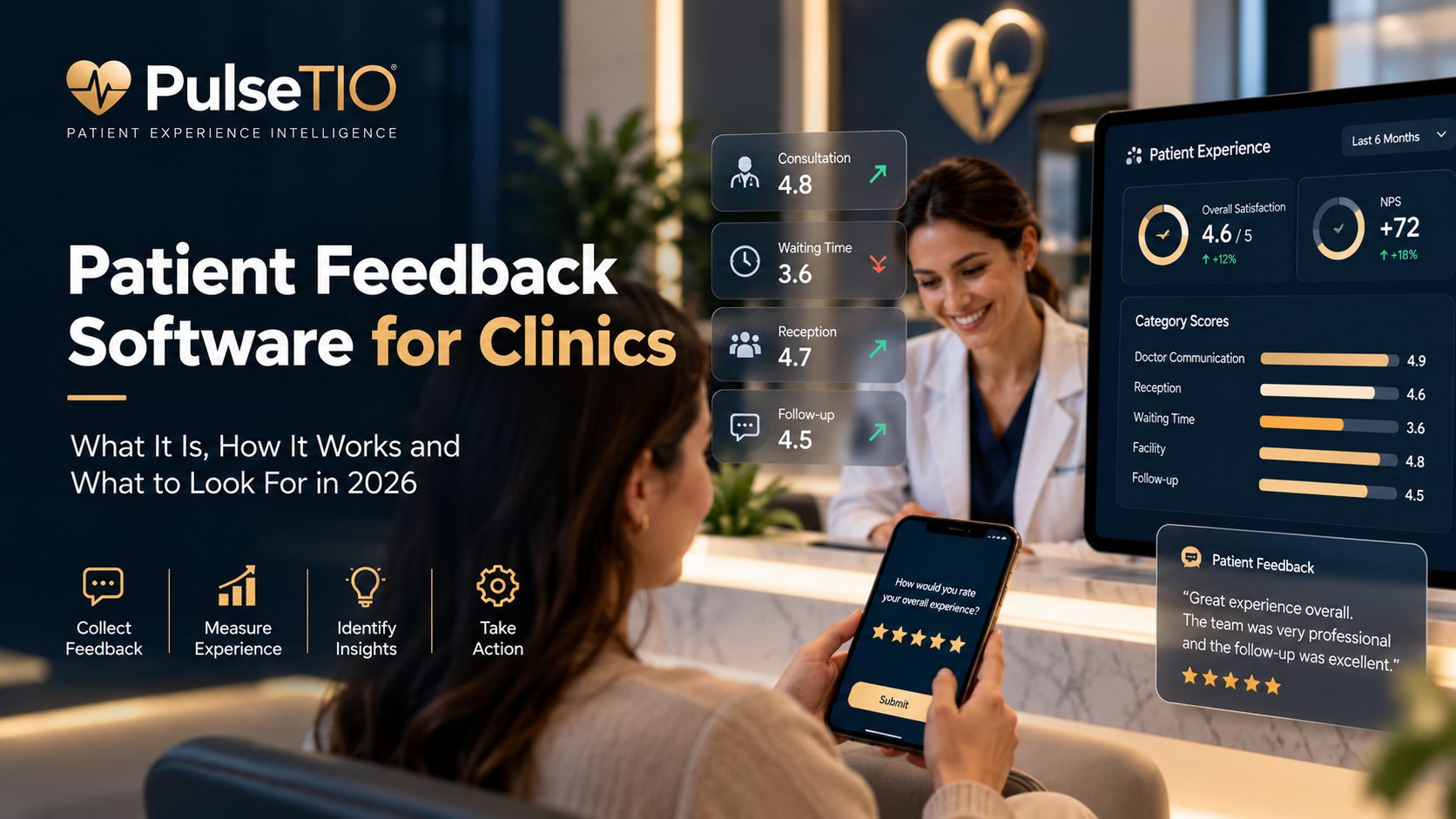
Patient Feedback Software for Clinics: What It Is, How It Works and What to Look For in 2026
Patient feedback software helps clinics collect, measure and act on patient experience data. Learn how it works, which features matter and how to choose the right platform.
Most clinics already receive patient feedback.
The problem is that very little of it becomes useful data.
A patient tells the receptionist they were happy.
Another patient writes a Google review.
Someone sends a WhatsApp complaint.
A surgeon hears positive feedback during a follow-up.
A coordinator receives an unhappy email.
The information exists.
But it is fragmented.
It is rarely measured consistently.
And in many clinics, nobody can answer a seemingly simple question:
What are our patients actually experiencing right now?
That is the problem patient feedback software is designed to solve.
What Is Patient Feedback Software?
Patient feedback software is a digital system that helps clinics and healthcare organizations systematically collect, organize, analyze and act on feedback from patients.
Instead of relying on:
paper forms
individual complaints
verbal comments
occasional online reviews
staff memory
a patient feedback platform creates a structured system.
A typical workflow looks like this:
Patient interaction → Feedback request → Patient response → Analysis → Action
For example:
A patient completes a consultation.
Shortly afterwards, they receive a feedback request by SMS, WhatsApp or email.
The patient evaluates:
overall experience
doctor communication
waiting time
reception
follow-up
The clinic then sees the response inside a dashboard.
Over time, hundreds of individual responses become trends.
That is the important difference.
A single patient comment is feedback.
A pattern across hundreds of patients is patient experience intelligence.
Why Clinics Need More Than Google Reviews
Google reviews are valuable.
But they are not a complete patient experience measurement system.
A Google review is public feedback that a patient voluntarily decides to publish.
It usually does not provide structured information about individual parts of the patient journey.
A clinic might receive:
“Great doctor, but the overall experience could be better.”
That review does not necessarily tell management whether the problem was:
appointment scheduling
waiting time
reception
communication
billing
follow-up
Structured feedback can.
For example:
Doctor Communication: 4.9 / 5
Reception: 4.6 / 5
Facility: 4.8 / 5
Waiting Time: 3.3 / 5
Follow-Up: 3.5 / 5
Now the clinic has something actionable.
Google reviews measure part of public reputation.
Patient feedback software helps measure the experience creating that reputation.
Patient Experience Is Broader Than a Satisfaction Score
One of the biggest mistakes clinics make is reducing patient experience to a single question:
“Were you satisfied?”
The Agency for Healthcare Research and Quality's CAHPS framework looks at multiple dimensions of the healthcare experience, including communication, access to care, staff interaction and coordination.
AHRQ also recommends combining structured surveys with other quantitative and qualitative sources of patient feedback to identify strengths, weaknesses and improvement opportunities.
This makes sense.
Patient experience is not one moment.
It is a journey.
What Should Patient Feedback Software Measure?
Different clinics will need different metrics.
But there are several core areas worth measuring.
Overall Experience
Start with a simple benchmark.
For example:
How would you rate your overall experience today?
This creates an overall satisfaction trend.
But it should not be the only metric.
CSAT
CSAT — Customer Satisfaction Score — can measure satisfaction with specific interactions.
Examples:
consultation
reception
appointment scheduling
waiting time
follow-up
CSAT helps answer:
“How satisfied was the patient with this particular part of the journey?”
NPS
Net Promoter Score measures how likely a patient is to recommend the clinic.
The standard question is:
How likely are you to recommend our clinic to a friend or family member?
Responses are given on a 0–10 scale.
NPS measures advocacy rather than a specific interaction.
Category Ratings
A strong feedback platform should allow clinics to break the experience into meaningful categories.
For example:
doctor communication
nursing
reception
cleanliness
hospitality
waiting time
accessibility
follow-up
international patient coordination
These categories help management identify exactly where an experience problem originates.
Qualitative Feedback
Numbers tell you what happened.
Comments tell you why.
For example:
A patient gives waiting time:
2 / 5
The score identifies a problem.
Then they write:
“The wait itself was not the main issue. Nobody told me that the doctor was running late.”
Now the clinic understands the root cause.
The issue may actually be communication rather than scheduling.
How Does Patient Feedback Software Work?
Although platforms vary, the typical workflow has several stages.
Step 1: A Patient Interaction Occurs
A feedback process should be connected to a real patient journey.
For example:
consultation completed
treatment completed
procedure completed
discharge
follow-up appointment
telemedicine consultation
The stage determines which questions should be asked.
Step 2: The Patient Receives a Feedback Request
Feedback can be collected through multiple channels.
Common examples include:
SMS
email
WhatsApp
QR code
NFC
tablet or kiosk
Different channels work better in different environments.
A QR code may work well inside a clinic.
SMS or WhatsApp may work better after the patient leaves.
For international clinics, communication preferences may vary significantly between patient groups.
Step 3: The Patient Completes a Short Survey
Patient surveys should generally be easy to complete.
A post-visit survey might ask:
Overall experience
Doctor communication
Waiting time
Reception
NPS
Open feedback
The objective is not to ask every possible question.
It is to collect enough information to identify meaningful patterns.
Step 4: Responses Are Organized
This is where patient feedback software becomes significantly more useful than a standard survey form.
Responses should be connected to context.
For example:
clinic location
physician
procedure
survey type
visit date
language
patient journey stage
This allows management to compare experiences.
One location might have strong satisfaction.
Another may consistently struggle with waiting times.
One procedure may receive excellent clinical scores but weaker follow-up ratings.
Without segmentation, these patterns disappear inside averages.
Step 5: Problems Are Identified
Feedback should not simply be stored.
It should help reveal areas that require attention.
For example:
Overall Satisfaction: 4.7 / 5
Looks excellent.
But:
Waiting Time: 3.2 / 5
Management now knows where to investigate.
A more advanced system may also identify:
recurring complaints
negative sentiment
declining categories
sudden changes
dissatisfied patient responses
The goal is early visibility.
Step 6: The Clinic Takes Action
This is the stage many feedback programs miss.
Collecting feedback does not improve patient experience.
Acting on feedback does.
AHRQ's patient experience improvement guidance emphasizes analyzing feedback to identify strengths and weaknesses and then developing improvement strategies around those findings.
For example:
Feedback reveals:
Waiting-time satisfaction declined for three consecutive months.
The clinic investigates.
It discovers appointments scheduled between 14:00 and 16:00 regularly run behind.
Management changes scheduling buffers.
Three months later:
Waiting-time satisfaction improves.
That is a feedback loop.
Why Real-Time Feedback Matters
Traditional patient surveys may be reviewed monthly, quarterly or even annually.
That may be useful for benchmarking.
But private clinics often need faster visibility.
Imagine a clinic suddenly receives multiple complaints about:
a new receptionist
appointment communication
post-operative follow-up
a specific coordinator
If management only looks at patient experience every three months, the clinic may continue delivering the same poor experience to hundreds of patients.
Real-time or near-real-time feedback can help teams identify problems earlier.
This does not mean management should react dramatically to every negative response.
One complaint may be an exception.
Ten similar complaints are a signal.
Patient Feedback Software vs General Survey Tools
A general survey platform can collect answers.
That does not necessarily make it a patient experience platform.
Tools such as generic form builders can be useful for simple surveys.
But healthcare organizations often need more context.
Patient feedback software should ideally understand that a response belongs to:
a patient journey.
For example:
Patient → Consultation → Physician → Procedure → Location → Feedback → Follow-up
That context allows the feedback to become operationally useful.
A generic survey might tell you:
87 people selected 4 stars.
A patient experience system should help tell you:
Patients receiving procedure X have consistently rated follow-up communication lower than other patient groups during the past eight weeks.
Those are very different levels of intelligence.
What Features Should Clinics Look for in Patient Feedback Software?
This is where many clinic owners searching for software get overwhelmed.
Dozens of platforms may appear similar.
But several features make a meaningful difference.
1. Customizable Surveys
Every clinic is different.
A dermatology consultation should not necessarily use the same questionnaire as:
rhinoplasty
dental implants
ophthalmic surgery
bariatric surgery
fertility treatment
Your feedback system should allow surveys to match the patient journey.
2. Multiple Question Types
Useful survey formats include:
rating
NPS
multiple choice
yes/no
emoji
slider
free text
Different questions require different response formats.
3. Multilingual Surveys
This becomes essential for clinics treating international patients.
Patients may communicate adequately in English during a consultation but still express detailed feedback more accurately in their native language.
A multilingual survey system reduces this barrier.
4. Multi-Channel Delivery
Patients do not all respond through the same channel.
Useful options may include:
SMS
WhatsApp
email
QR
NFC
The easier the survey is to access, the more likely patients are to respond.
5. NPS and CSAT Tracking
The platform should calculate experience metrics automatically rather than requiring manual spreadsheets.
More importantly, it should show trends.
A single NPS score is less useful than seeing how NPS changes over six months.
6. Category-Level Analysis
Overall satisfaction can hide important problems.
Look for the ability to analyze categories such as:
communication
waiting
reception
facility
follow-up
This makes feedback actionable.
7. Open-Text Feedback
Do not rely only on numbers.
Patients often explain the most valuable problems in their own words.
Qualitative feedback should be easy to review alongside quantitative scores.
8. Trend Analysis
Management should be able to answer:
Are we improving?
A good platform should show changes over time.
For example:
Waiting time:
January: 3.6
February: 3.7
March: 4.0
April: 4.3
Now improvement becomes measurable.
9. Segmentation
Feedback becomes significantly more powerful when it can be filtered by:
doctor
clinic
location
procedure
date
survey
language
Without segmentation, averages can hide important operational differences.
10. A Simple Dashboard
More data is not always better.
A dashboard should quickly answer:
Are patients satisfied?
Would they recommend us?
What is getting worse?
What is improving?
Where are the problems?
What are patients saying?
If management needs a data analyst simply to understand the patient experience, the software has probably become too complicated.
Should Patient Feedback Software Include Google Reviews?
This requires an important distinction.
Patient feedback and public reviews are connected.
But they are not the same thing.
Google reviews are part of reputation.
Patient feedback is part of experience measurement.
A patient experience platform can make it easy for patients to access a public review destination.
However, clinics should not manipulate who is permitted or encouraged to review based on predicted sentiment.
Google's policies prohibit selectively soliciting positive reviews or discouraging negative ones.
So the correct model is not:
Happy patient → Google
Unhappy patient → Hidden
Instead:
Collect genuine patient feedback.
Improve the experience.
Provide policy-compliant opportunities for patients to share genuine public reviews.
Better reputation should emerge from better experience.
Can Patient Feedback Software Improve Google Reviews?
Indirectly, yes.
But not because software magically creates five-star reviews.
Consider this chain:
Patient feedback identifies repeated waiting-time complaints.
The clinic changes scheduling.
Waiting-time satisfaction improves.
Patients have a better overall experience.
More patients become willing to recommend the clinic.
Public reputation can improve naturally over time.
This is a much healthier model than trying to manipulate review acquisition.
Can Small Clinics Use Patient Feedback Software?
Yes.
In fact, smaller private clinics may benefit significantly because they often have fewer management layers.
A problem can be identified and fixed quickly.
A five-person clinic may not need an enterprise patient experience platform designed for a hospital network with 50 locations.
It may need something much simpler:
easy survey creation
automated feedback
NPS
satisfaction ratings
multilingual support
dashboard reporting
review destination integration
The software should match the complexity of the organization.
Patient Feedback Software for International Clinics
Medical tourism creates additional patient experience challenges.
The patient journey can include:
initial inquiry
remote consultation
treatment planning
travel
airport transfer
accommodation
hospital admission
procedure
recovery
discharge
return home
remote follow-up
A patient may be highly satisfied with surgery but dissatisfied with transportation.
Or the medical outcome may be excellent while post-operative communication feels inadequate.
A single overall rating cannot reveal these differences.
For international clinics, patient feedback software should therefore support:
multiple languages
different journey stages
customizable questions
follow-up surveys
segmentation
This turns the entire medical tourism journey into something measurable.
What Questions Should You Ask Before Choosing Patient Feedback Software?
Before buying a platform, ask:
Can surveys be customized to our clinic?
Can we measure NPS and CSAT?
Can patients respond in different languages?
Can surveys be delivered through the channels our patients actually use?
Can we analyze feedback by location, doctor or treatment?
Can we identify negative experiences quickly?
Can we see trends over time?
Can patients leave qualitative comments?
Is the dashboard understandable without specialist training?
Can the system grow with our clinic?
The best patient feedback software is not necessarily the platform with the most features.
It is the one that makes patient experience easier to measure, understand and improve.
Where PulseTIO Fits
PulseTIO is designed specifically around patient experience intelligence for clinics and healthcare professionals.
Instead of treating feedback as an isolated form, PulseTIO connects it to a structured patient journey.
Clinics can create customizable surveys using:
ratings
NPS
multiple choice
yes/no
emoji
sliders
open-text questions
Feedback can be collected across multiple touchpoints and analyzed through a centralized dashboard.
PulseTIO also supports multilingual feedback, making it particularly relevant for clinics treating international patients.
The goal is not simply to collect more responses.
It is to transform individual patient experiences into information a clinic can actually use.
The Future of Patient Feedback Is Not More Surveys
The healthcare industry does not need more forms.
It needs better understanding.
A patient feedback system should help a clinic move from:
“We think patients are happy.”
to:
“Our overall satisfaction is stable, but waiting-time satisfaction has declined 14% over the past two months.”
From:
“We received a complaint.”
to:
“Communication is becoming a recurring issue among our international patients.”
And from:
“Our Google rating went down.”
to:
“We understand which part of the patient journey is creating dissatisfaction — and we can fix it.”
That is the difference between collecting feedback and managing patient experience.
And increasingly, that difference is why clinics are moving from simple survey tools toward dedicated patient feedback software.
Frequently Asked Questions
Common questions and answers regarding this topic.
Q.What is patient feedback software?
Patient feedback software helps healthcare organizations systematically collect, organize and analyze patient feedback across different stages of the patient journey.
Q.What is the best patient feedback software for clinics?
The best platform depends on the clinic's needs, but important capabilities include customizable surveys, NPS and CSAT measurement, multilingual feedback, multi-channel delivery, segmentation, qualitative comments and trend analysis.
Q.How do clinics collect patient feedback?
Clinics can collect patient feedback through SMS, WhatsApp, email, QR codes, NFC, tablets and post-visit surveys. The most appropriate method depends on the patient journey and communication preferences.
Q.What is the difference between patient feedback software and survey software?
Survey software primarily collects responses. Patient feedback software is designed to connect those responses with healthcare context such as visits, locations, physicians, procedures and stages of the patient journey so organizations can identify operational patterns.
Q.Can patient feedback software help improve Google reviews?
It can help indirectly by identifying experience problems that clinics can correct. Better patient experiences can contribute to stronger patient advocacy and public reputation over time.
Q.What should patient feedback software measure?
Useful measures include overall satisfaction, CSAT, NPS, communication, waiting time, reception, follow-up, category-specific ratings and qualitative patient comments.
Q.When should clinics ask patients for feedback?
Feedback should generally be collected close to the experience being measured, such as after a consultation, treatment, procedure or follow-up.