How to Improve Patient Satisfaction and Build a Stronger Online Reputation for Your Clinic
Learn how to measure patient satisfaction, collect actionable feedback, improve clinic operations, and build a stronger online reputation without relying only on Google reviews.
Patient satisfaction is no longer just a measure of whether someone was happy with their treatment.
For modern clinics, it influences patient retention, referrals, online reputation, operational performance, and the confidence of prospective patients who are deciding where to book.
Yet many clinics still manage patient experience informally.
They rely on conversations at reception, occasional online reviews, complaints that reach the clinic manager, or assumptions about how patients feel.
The problem is simple:
By the time a dissatisfied patient leaves a public review, the clinic may be learning about the problem too late.
A structured patient feedback system gives clinics the opportunity to understand the patient experience earlier, identify recurring issues, and continuously improve the journey from first contact to follow-up.
This guide explains how.
What Is Patient Satisfaction in Healthcare?
Patient satisfaction describes how patients evaluate their overall experience with a healthcare provider or clinic.
Clinical outcome is important, but it is only one part of that experience.
Patients may also evaluate:
Communication with the doctor
Reception and administrative experience
Waiting time
Staff attitude
Information provided before and after treatment
Ease of scheduling
Follow-up communication
Clinic environment
Whether expectations were properly managed
This means a technically successful treatment does not always guarantee a positive patient experience.
Likewise, a problem that appears small from the clinic's perspective may significantly affect how the patient evaluates the entire visit.
That is why patient satisfaction should be measured rather than assumed.
Why Patient Experience Matters for Clinic Reputation
Most prospective patients now encounter a clinic digitally before they ever speak to a member of staff.
They may find the clinic through Google, social media, an AI assistant, a recommendation, or a medical tourism platform.
Before making contact, many will look for signals of trust.
These can include:
Google ratings
Recent patient reviews
The volume and consistency of feedback
Responses to negative reviews
Testimonials
The clinic's digital presence
How other patients describe their experience
Online reputation is therefore not separate from patient experience.
It is increasingly the public reflection of it.
The better a clinic understands what happens during the patient journey, the better it can manage the factors that eventually influence reputation.
The Problem With Waiting for Google Reviews
Google reviews are valuable, but they are a lagging indicator.
A review tells you what a patient decided to say publicly after the experience has already happened.
It does not necessarily tell you:
Where in the journey the problem occurred
Whether similar patients are experiencing the same issue
Whether satisfaction is improving or declining
Which department needs attention
Whether waiting time is affecting overall satisfaction
Whether communication problems occur before or after treatment
For clinic management, structured feedback provides a much more useful layer of information.
A public review might say:
“The overall experience could have been better.”
Structured feedback can reveal that the medical consultation was rated highly, while waiting time and pre-appointment communication received low scores.
That difference matters.
One is a comment.
The other is actionable information.
1. Collect Feedback While the Experience Is Still Fresh
Timing has a major impact on feedback quality.
If a clinic asks a patient about their experience several weeks later, details may already be forgotten.
A more effective approach is to request feedback shortly after an important interaction.
For example:
After a consultation
After treatment
After a procedure
After a follow-up appointment
After discharge
After an online consultation
The patient can receive a short feedback request through channels such as:
SMS
WhatsApp
Email
QR code
NFC
The objective should not be to overwhelm patients with long questionnaires.
A well-designed survey can often begin with one simple question:
How was your experience today?
Additional questions can then explore the reasons behind the answer.
2. Ask Questions That Can Lead to Action
A survey should not collect data simply because the data is available.
Every question should help the clinic understand or improve something.
Useful areas may include:
Overall satisfaction
How would the patient rate the overall visit?
Communication
Did the patient understand the information provided?
Doctor experience
Did the patient feel heard and properly informed?
Reception
Was the administrative process clear and professional?
Waiting time
Was the patient seen within an acceptable period?
Hospitality
Did the patient feel comfortable and welcomed?
Recommendation
How likely would the patient be to recommend the clinic?
These answers can be measured individually and compared over time.
This gives clinic managers visibility into areas that would otherwise remain subjective.
3. Use NPS and CSAT — But Do Not Depend on One Number
Two common patient experience metrics are NPS and CSAT.
CSAT — Customer Satisfaction Score
CSAT usually asks patients to rate satisfaction with a specific experience.
For example:
How satisfied were you with your visit today?
It is particularly useful for measuring individual touchpoints.
NPS — Net Promoter Score
NPS asks how likely someone is to recommend an organization to another person.
It provides a broader indication of loyalty and advocacy.
Both metrics can be useful, but neither should be viewed in isolation.
A clinic can have a strong overall satisfaction score while still having recurring problems with:
waiting time
communication
appointment scheduling
postoperative follow-up
The real value comes from combining the headline metric with the reasons behind it.
4. Identify Negative Experiences Before They Escalate
One of the most valuable functions of a structured patient feedback system is early detection.
Consider two scenarios.
Without a feedback system
A patient has a poor experience.
The clinic does not know.
Several days later, the patient posts a critical public review.
The clinic responds after the issue has already become visible.
With a feedback system
The same patient receives a post-visit survey.
The patient reports dissatisfaction and explains what happened.
The clinic is notified.
A team member can review the case and respond appropriately.
The important point is not to prevent the patient from expressing a genuine opinion publicly.
It is to ensure the clinic does not have to rely on a public complaint to discover a service problem.
That is a fundamentally different approach to reputation management.
5. Treat Negative Feedback as Operational Intelligence
Negative feedback can be uncomfortable, but it is often the most valuable feedback a clinic receives.
Patterns can reveal operational weaknesses that may otherwise remain invisible.
For example:
If multiple patients report long waiting times, the issue may involve scheduling.
If patients repeatedly score communication poorly, information before treatment may need improvement.
If satisfaction is high for the physician but low for reception, the problem is probably not clinical.
If international patients report confusion after treatment, multilingual follow-up materials may be needed.
A mature patient experience system converts these individual comments into trends.
That allows the clinic to move from:
“A patient complained.”
to:
“This is a recurring operational issue affecting 14% of our recent patients.”
That is a much more useful management conversation.
6. Ask for Google Reviews in a Policy-Compliant Way
Google reviews can be an important part of a clinic's reputation, but review collection must be handled carefully.
Clinics should avoid practices designed to artificially influence ratings.
This includes:
Offering discounts or rewards in exchange for reviews
Asking patients specifically for five-star reviews
Preventing dissatisfied patients from accessing review options
Only requesting public reviews from patients who gave positive private feedback
Telling patients what they should write
The better approach is simple:
Ask for genuine feedback without manipulating the outcome.
Patients should remain free to share their real experience.
A patient experience platform can make the review process easier, but it should not be used to manufacture a particular rating.
The objective is not to create perfect reviews.
It is to create a better patient experience that naturally produces stronger advocacy over time.
7. Make Feedback Easy for International Patients
Language becomes particularly important for clinics treating international patients.
A patient may understand enough English to communicate during treatment but still struggle to describe a detailed experience accurately.
If feedback is collected only in one language, clinics may lose valuable insight.
A multilingual feedback process allows patients to respond in a language they are more comfortable using.
For medical tourism clinics, this can improve:
response rates
clarity
quality of feedback
identification of communication problems
post-treatment support
PulseTIO supports multilingual patient feedback flows so clinics can collect structured experience data from different patient groups without building separate systems for each language.
8. Monitor Trends Instead of Individual Reviews
One review rarely tells the whole story.
What matters more is the pattern.
Clinic managers should regularly monitor questions such as:
Is overall satisfaction increasing?
Has NPS changed this month?
Which category receives the lowest ratings?
Is waiting-time satisfaction improving?
Are certain procedures receiving different feedback?
Are complaints concentrated around a specific stage of the patient journey?
Are more patients responding to feedback requests?
This turns patient experience into something measurable.
Instead of reacting to individual reviews, the clinic can manage experience proactively.
9. Create a Continuous Patient Experience Loop
An effective clinic feedback system can be understood as a simple cycle:
1. Capture
Request feedback after meaningful patient interactions.
2. Understand
Collect structured scores and qualitative comments.
3. Identify
Detect dissatisfaction and recurring patterns.
4. Act
Make operational or communication improvements.
5. Measure
Track whether those changes improve satisfaction.
6. Repeat
Continue collecting feedback and improving the patient journey.
This is where patient experience becomes more than a survey.
It becomes an operational system.
From Patient Feedback to Patient Experience Intelligence
Traditional feedback tools tell clinics what a patient said.
Patient Experience Intelligence goes further.
It helps clinics understand:
what patients are experiencing
why satisfaction changes
where problems are occurring
which improvements are working
how experience influences reputation over time
That is the philosophy behind PulseTIO.
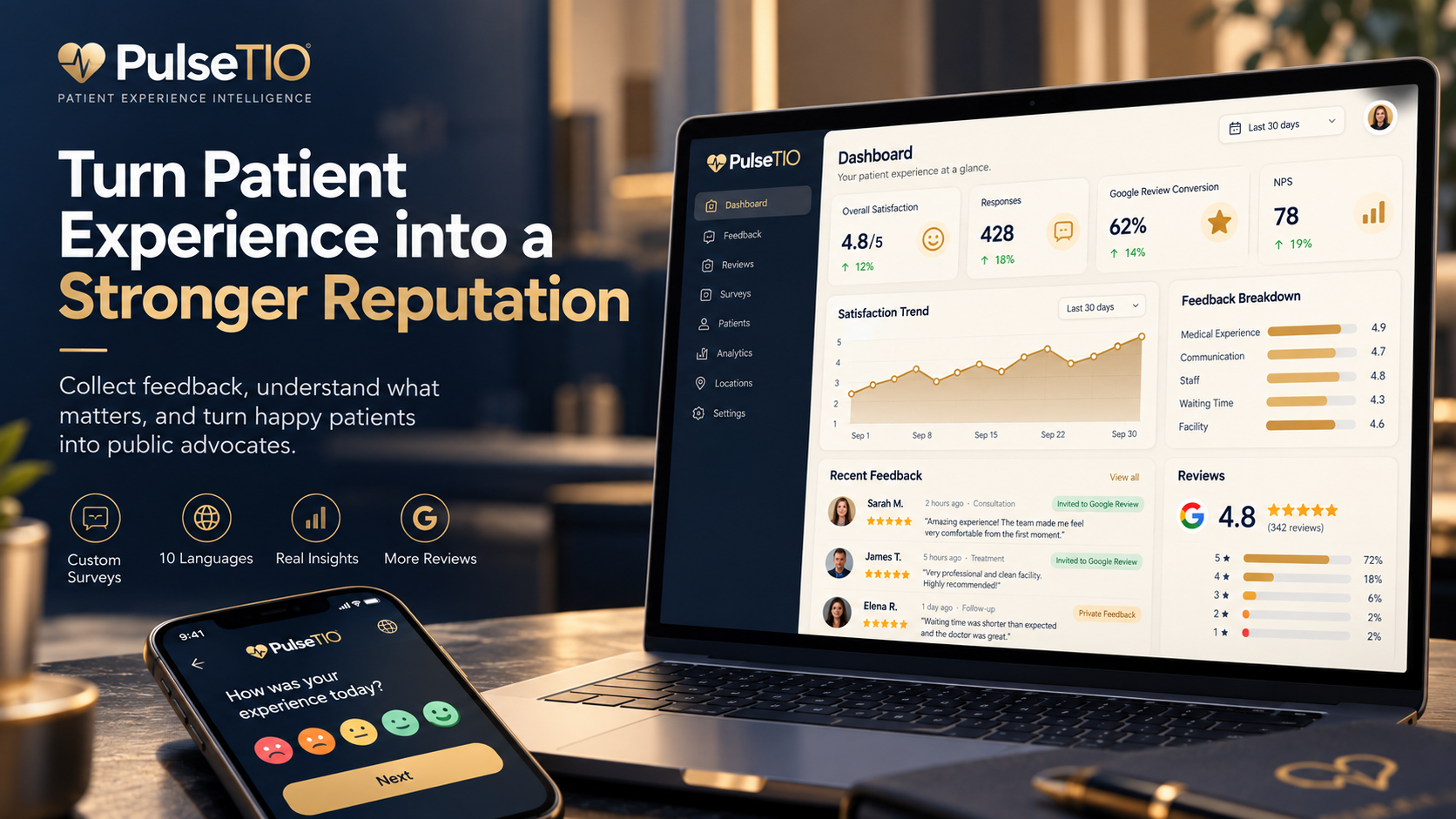
PulseTIO is a Patient Experience Intelligence Platform designed for clinics and healthcare professionals.
It helps clinics:
collect structured patient feedback
create customizable surveys
communicate through multiple channels
support multilingual patient journeys
track NPS and satisfaction metrics
identify recurring experience issues
analyze trends
manage patient feedback from one dashboard
connect patient experience with online reputation
The goal is not simply to generate more reviews.
The goal is to help clinics build an experience worth recommending.
The Bottom Line
Online reputation does not begin on Google.
It begins inside the patient journey.
Clinics that consistently measure patient experience can discover problems earlier, make better operational decisions and understand what patients actually value.
Google reviews then become something different:
not the starting point of reputation management,
but one of the outcomes of a well-managed patient experience.
Measure the experience. Understand it. Improve it. Let reputation follow.
Frequently Asked Questions
Common questions and answers regarding this topic.
Q.What is the best way to measure patient satisfaction in a clinic?
A combination of structured post-visit surveys, CSAT, NPS, category-specific ratings and qualitative feedback usually provides more useful information than relying on a single metric.
Q.When should a clinic request patient feedback?
Feedback should generally be requested soon after a meaningful patient interaction, while the experience is still fresh. This may be after a consultation, treatment, procedure or follow-up visit.
Q.Can patient feedback improve Google reviews?
Indirectly, yes. Patient feedback helps clinics identify and improve experience problems. Better patient experiences can contribute to stronger organic advocacy and more positive public reviews over time.
Q.Should clinics only ask satisfied patients for Google reviews?
No. Selectively requesting reviews only from satisfied patients can violate Google's policies on rating manipulation. Review requests should not be designed to suppress negative opinions or artificially inflate ratings.
Q.What should a clinic do with negative patient feedback?
Negative feedback should be reviewed promptly, investigated where appropriate, and used to identify possible communication, operational or service problems. Repeated complaints should be analyzed as trends rather than isolated events.
Q.Is NPS useful for healthcare clinics?
Yes, but it should not be used alone. NPS is useful for measuring recommendation intent, while more specific questions can explain what is driving that score.
Q.Can PulseTIO be used by medical tourism clinics?
Yes. PulseTIO is designed to support healthcare organizations that work with local and international patients, including multilingual feedback workflows.