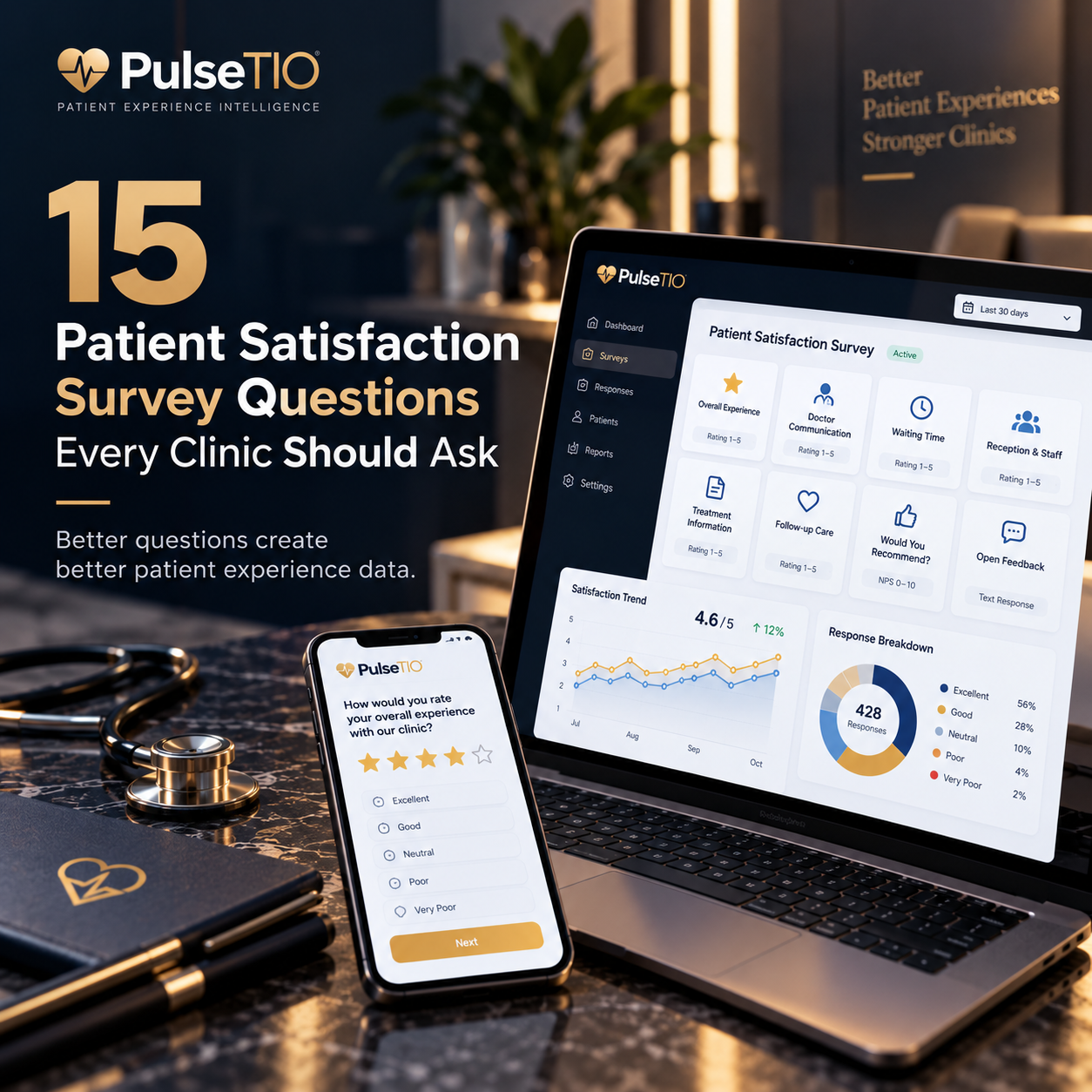
15 Patient Satisfaction Survey Questions Every Clinic Should Ask
Discover 15 patient satisfaction survey questions clinics can use to measure communication, waiting time, follow-up, NPS and the overall patient experience.
Patient satisfaction surveys often fail for one simple reason:
Clinics ask questions, but they do not ask questions that lead to action.
A patient may complete a survey.
The clinic receives a score.
The dashboard shows an average.
But nothing changes.
That is not patient experience management.
A useful patient survey should help a clinic understand where the patient journey is working, where it is breaking down, and what should be improved next.
Healthcare patient experience is broader than a single satisfaction score. Organizations such as AHRQ and CMS measure areas including access to care, communication with clinicians, coordination, staff interactions and overall experience.
So instead of asking only:
“Were you satisfied?”
clinics should ask questions that reveal what actually happened.
Here are 15 patient satisfaction survey questions that can help.
1. How Would You Rate Your Overall Experience With Our Clinic?
This is the most useful starting point.
A simple 1–5 rating gives the clinic a broad view of the patient's experience.
For example:
How would you rate your overall experience with our clinic today?
1 — Very Poor
2 — Poor
3 — Neutral
4 — Good
5 — Excellent
This question is valuable because it creates a consistent benchmark.
Over time, the clinic can monitor whether overall experience is improving or declining.
But this score should never stand alone.
The next questions should help explain why the patient selected that rating.
2. How Easy Was It to Schedule Your Appointment?
Patient experience often begins before the patient enters the clinic.
Appointment scheduling can influence how someone evaluates the entire journey.
Ask:
How easy was it to schedule your appointment?
You may discover problems such as:
slow response times
complicated booking processes
unclear availability
unanswered messages
language barriers
inconvenient appointment options
AHRQ patient experience frameworks specifically include timely access to appointments and information as important parts of care experience.
3. Were You Given Clear Information Before Your Visit?
Patients often arrive at a clinic with questions.
Where should they go?
What should they bring?
Should they eat before the procedure?
How long will the appointment take?
Will they need someone to accompany them?
Ask:
Was the information provided before your appointment clear and helpful?
This is particularly important for:
surgical clinics
dental clinics
aesthetic procedures
international patients
diagnostic procedures
treatments requiring preparation
Poor pre-visit communication can create anxiety before the medical interaction even begins.
4. How Would You Rate Your Reception Experience?
Reception is one of the most visible operational touchpoints in the patient journey.
Ask:
How would you rate your experience with our reception team?
Possible follow-up areas include:
friendliness
professionalism
clarity
speed
helpfulness
AHRQ's CAHPS framework specifically measures whether office staff are helpful, courteous and respectful.
This makes reception experience worth measuring independently instead of hiding it inside an overall clinic score.
5. How Satisfied Were You With Your Waiting Time?
Waiting time can significantly affect how patients perceive a visit.
Ask:
How satisfied were you with the waiting time before your consultation or treatment?
You can use a five-point scale.
But consider adding a follow-up question when the score is low:
What could we have done better?
This helps distinguish between:
objectively long waiting times
poor communication about delays
scheduling problems
unexpected emergencies
patient expectations
Sometimes the problem is not simply the delay.
It is that nobody explained the delay.
6. Did the Doctor Listen Carefully to Your Concerns?
Clinical communication deserves its own measurement.
Ask:
Did the doctor listen carefully to your concerns?
Possible responses:
Definitely yes
Mostly yes
Neutral
Mostly no
Definitely no
Patients want to feel that their concerns have been heard.
AHRQ's patient experience measures include whether clinicians listen carefully, explain information clearly and show respect for what patients say.
7. Did the Doctor Explain Your Treatment Clearly?
Medical knowledge does not automatically create good patient communication.
Ask:
Did the doctor explain your condition, treatment or procedure in a way that was easy to understand?
A patient can receive excellent medical care and still leave confused.
That confusion may later create:
unnecessary anxiety
repeated questions
dissatisfaction
unrealistic expectations
poor adherence to instructions
Communication should therefore be measured independently from clinical satisfaction.
8. Did You Feel Comfortable Asking Questions?
Patients may understand what they are told but still feel uncomfortable asking questions.
Ask:
Did you feel comfortable asking questions during your consultation?
This question helps measure psychological safety within the interaction.
If patients consistently score this area poorly, the problem may not be the information itself.
It may be the way communication is taking place.
9. Did You Feel Treated With Respect?
Respect is fundamental to patient experience.
Ask:
Did you feel that you were treated with courtesy and respect throughout your visit?
This can include interactions with:
physicians
nurses
coordinators
reception staff
assistants
Respect and courteous communication are recurring themes in established patient experience frameworks.
10. Were Your Treatment or Procedure Instructions Clear?
This is particularly important for clinics performing procedures.
Ask:
Were the instructions provided before and after your treatment clear?
This can include:
medication instructions
wound care
activity restrictions
recovery expectations
follow-up appointments
warning signs
contact information
A strong consultation can still become a poor patient experience if the patient feels lost after leaving the clinic.
11. How Would You Rate Your Follow-Up Experience?
Patient experience does not end when the patient walks out the door.
Ask:
How would you rate the follow-up communication you received after your visit or treatment?
Possible areas include:
speed of response
availability
clarity
empathy
helpfulness
For surgical and medical tourism clinics, follow-up may be one of the most important stages of the journey.
12. How Easy Was It to Contact the Clinic When You Needed Help?
This question measures accessibility.
Ask:
How easy was it to reach our clinic when you had a question or needed assistance?
Possible responses:
1 — Very difficult
2 — Difficult
3 — Neutral
4 — Easy
5 — Very easy
If patients struggle to contact the clinic, dissatisfaction may increase even if the medical care itself was excellent.
That problem may be caused by:
unanswered WhatsApp messages
poor phone availability
unclear communication channels
slow email responses
weak escalation processes
This is an operational problem that can be measured and improved.
13. How Likely Are You to Recommend Our Clinic?
This is the classic NPS question.
Ask:
How likely are you to recommend our clinic to a friend or family member?
Score: 0–10.
Patients are then grouped into:
Promoters: 9–10
Passives: 7–8
Detractors: 0–6
NPS provides a broader view of advocacy.
But do not stop at the number.
Immediately follow with:
What is the main reason for your score?
That second question is often more useful than the NPS value itself.
14. What Could We Have Done Better?
Every clinic should include at least one open-ended question.
Ask:
What could we have done better during your experience?
Open comments allow patients to report issues the clinic may not have anticipated.
For example:
A clinic may believe waiting time is the main problem.
Patients may actually be frustrated by:
parking
payment communication
post-treatment instructions
coordination
language
appointment reminders
Open-ended patient narratives are also used within AHRQ's CAHPS framework because qualitative feedback can provide additional insight into patient experience.
15. Is There Anything Else You Would Like Us to Know?
End with a simple invitation:
Is there anything else you would like us to know about your experience?
Do not underestimate this question.
Sometimes the most valuable feedback does not fit inside a predefined category.
Patients may mention:
a staff member who helped them
an unexpected problem
a suggestion
a communication issue
something they appreciated
Structured data creates consistency.
Open feedback creates context.
A good patient experience system needs both.
The Best Patient Survey Is Not the Longest One
A common mistake is trying to measure everything in one survey.
Clinics sometimes create questionnaires with:
20 questions.
30 questions.
Sometimes more.
The result?
Patients stop responding.
The objective should not be to collect the maximum possible amount of information.
It should be to collect the minimum amount of information needed to make a better decision.
A short post-visit survey might include:
Overall experience
Doctor communication
Waiting time
Reception experience
NPS
Open feedback
That may be enough.
For another clinic, follow-up communication may be more important.
The survey should reflect the patient journey.
Not a generic questionnaire template.
Not Every Patient Should Receive the Same Survey
This is another important point.
A patient who attended a 15-minute consultation should not necessarily receive the same questionnaire as someone who underwent surgery.
Different journeys require different questions.
For example:
Consultation Patient
Measure:
appointment process
waiting time
doctor communication
overall satisfaction
Surgical Patient
Measure:
pre-operative information
hospital experience
communication
recovery instructions
follow-up
NPS
International Patient
Measure:
coordinator communication
language support
travel information
transfers
accommodation coordination
treatment experience
follow-up after returning home
Returning Patient
Measure:
consistency
relationship with clinic
ease of communication
overall loyalty
Customization creates better data.
Ask the Right Question at the Right Time
Timing matters as much as question design.
Imagine asking:
How satisfied were you with your follow-up care?
immediately after the procedure.
The patient has not experienced follow-up yet.
The question is meaningless.
Instead, surveys should match patient journey milestones.
For example:
After consultation
Measure consultation experience.
After procedure
Measure treatment-day experience.
Several days later
Measure recovery communication.
After follow-up
Measure overall journey and NPS.
Patient experience measurement should follow the journey instead of forcing everything into one questionnaire.
Use Branching Questions
Every patient does not need to answer every question.
Survey branching can create much better experiences.
For example:
How would you rate your waiting time?
If the patient selects:
4 or 5
continue.
If the patient selects:
1 or 2
ask:
What was the main problem?
Options:
Wait was too long
I was not informed about the delay
Appointment started late
Other
Now the clinic does not simply know:
Waiting time score: 2/5
It knows why.
That is actionable data.
Measure Trends, Not Individual Complaints
One negative response is important.
But ten patients reporting the same issue is a pattern.
Clinics should therefore monitor:
satisfaction over time
NPS trends
recurring complaints
waiting-time scores
doctor communication scores
follow-up satisfaction
survey response rates
qualitative themes
Suppose one patient writes:
“Nobody answered my WhatsApp message.”
That may be an isolated problem.
But if 17 patients report communication problems in one month, the clinic has identified an operational issue.
That is where feedback becomes intelligence.
Do Not Design Surveys Only to Generate Reviews
Patient surveys should not exist simply to create more five-star reviews.
That approach misses the bigger opportunity.
Feedback should help clinics:
understand patients
identify problems earlier
improve operations
measure change
strengthen relationships
improve the overall patient journey
Better reputation should be the consequence of a better experience.
Not the only objective.
From Patient Survey to Patient Experience Intelligence
Collecting answers is easy.
Understanding them is harder.
A clinic may receive hundreds of survey responses.
The real questions are:
What is changing?
Where are patients becoming less satisfied?
Which part of the journey is responsible?
Is the problem recurring?
Did our improvement actually work?
This is where PulseTIO goes beyond a basic survey tool.
PulseTIO allows clinics to create customizable patient feedback flows using different question types, including:
ratings
NPS
choice questions
yes/no questions
emoji feedback
sliders
open text responses
Clinics can build surveys around their own patient journey instead of forcing every patient through the same questionnaire.
Feedback can then be analyzed through a central patient experience dashboard.
The objective is simple:
Ask better questions.
Understand the answers.
Improve the experience.
Because the quality of your patient experience data depends first on the quality of the questions you ask.
Frequently Asked Questions
Common questions and answers regarding this topic.
Q.What questions should a patient satisfaction survey include?
A patient satisfaction survey can include questions about overall experience, appointment scheduling, waiting time, reception, doctor communication, treatment information, follow-up, accessibility, NPS and open-ended feedback.
Q.How many questions should a patient satisfaction survey have?
There is no universal number. Clinics should keep surveys focused on the most important patient journey touchpoints. Shorter surveys with relevant questions are often easier for patients to complete than long generic questionnaires.
Q.When should clinics send patient satisfaction surveys?
The timing should match the experience being measured. Consultation feedback can be requested soon after the visit, while questions about recovery or follow-up should be sent later in the patient journey.
Q.What is the best question for measuring overall patient satisfaction?
A simple question such as “How would you rate your overall experience with our clinic?” provides a useful benchmark when combined with more specific questions that explain the score.
Q.Should clinics include open-ended questions in patient surveys?
Yes. Open-ended questions allow patients to describe issues or positive experiences that predefined ratings may not capture.
Q.Can patient surveys measure NPS?
Yes. Clinics can include the standard 0–10 recommendation question to measure Net Promoter Score alongside other patient experience metrics.